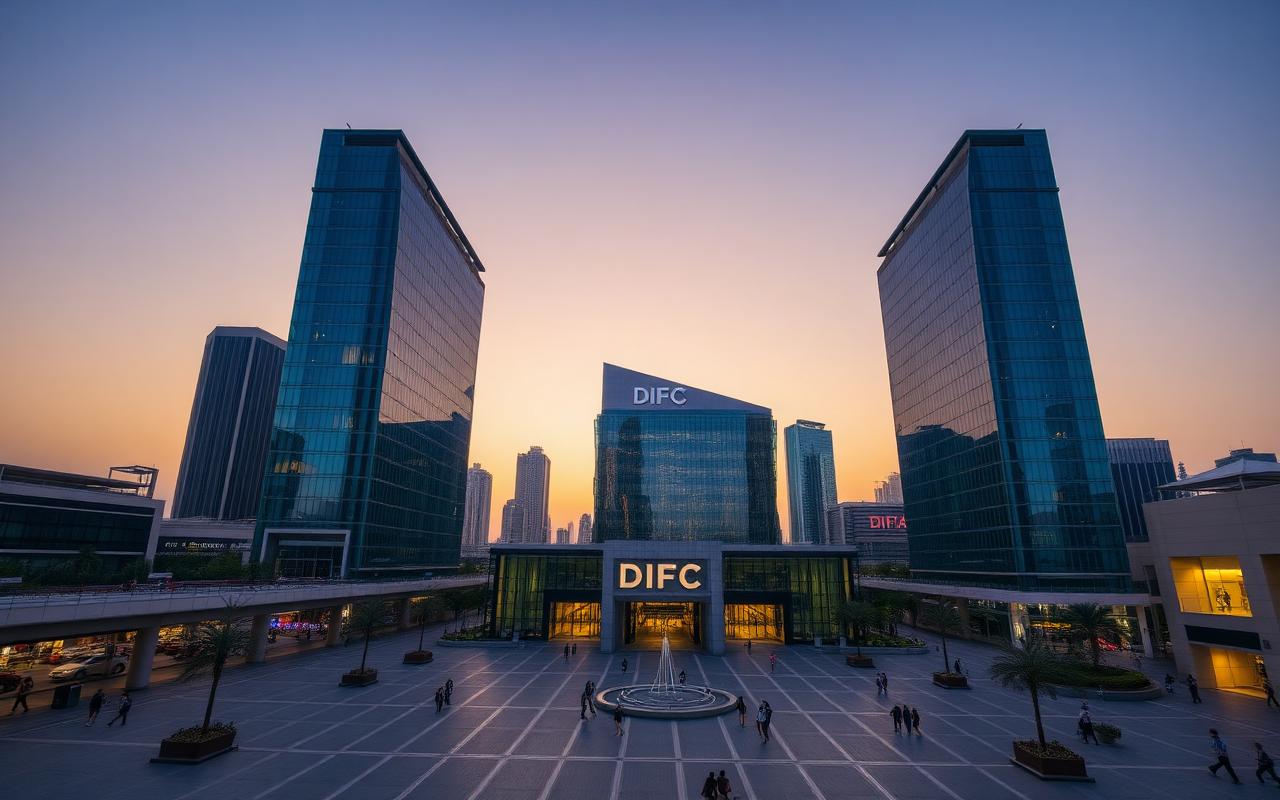
The Dubai International Financial Centre is a free zone of a particular kind: it has its own legislation based on English common law, its own English-language courts and its own financial regulator, the DFSA. For a consultancy, a family office or a fintech, setting up there is an immediate credibility signal to institutional clients.
That credibility comes at a price, and it does not suit every activity. This guide details licence types, real costs, rent levels and the profiles for which DIFC is a good choice, or a bad one.
Why DIFC is different from a classic free zone
Most Dubai free zones sell a fast, cheap licence. DIFC sells a legal environment: contract law modelled on common law, its own courts issuing judgments in English, and easier enforcement of international contracts. For an asset manager, a fund or an advisory firm signing with institutional clients, this framework removes frictions that local civil law does not.
It is also a district: Gate Avenue and Gate Village concentrate business restaurants, galleries and hotels. A DIFC office works as a prestige address for a corporate clientele.
Regulated and non-regulated licences
Financial activities (asset management, banking, insurance, brokerage, investment advice) fall under the DFSA, DIFC's financial regulator. The approval process is demanding: detailed business plan, capital requirements, approved executives. Allow several months and specialist support.
Non-regulated activities (strategy consulting, technology, holdings, family offices, high-end retail and dining) register with the DIFC Registrar of Companies, in a process close to a classic free zone: a few weeks for a clean file.
| Licence type | Authority | Indicative timeline | Activities |
|---|---|---|---|
| DFSA regulated | Dubai Financial Services Authority | 3 to 6 months | Asset management, brokerage, banking, insurance |
| Non-regulated | DIFC Registrar of Companies | 2 to 4 weeks | Consulting, tech, holding, family office |
| Retail and F&B | DIFC Registrar | 4 to 8 weeks | District restaurants, galleries, boutiques |
| Innovation Licence | DIFC Innovation Hub | 2 to 4 weeks | Early-stage tech and fintech startups |
What a DIFC set-up actually costs
DIFC is one of the most expensive jurisdictions in the UAE. For a simple non-regulated structure, a realistic first-year budget sits between 40,000 and 80,000 AED with a small office, versus 25,000 to 40,000 AED in a generalist free zone. DFSA-regulated licences add application fees and capital requirements.
| Item | Indicative amount | Note |
|---|---|---|
| Non-regulated company registration | 8,000 to 15,000 AED | Initial fees and annual licence |
| Innovation Hub licence | USD 1,500 to 6,000 | Startup formula, conditions apply |
| Office rent, annual per sqft | 180 to 350 AED | Among the highest in Dubai |
| Innovation Hub flexi desk | USD 500 to 1,000 per month | Most accessible entry point |
| Visa per person | 4,000 to 7,000 AED | Medical and Emirates ID included |
| Data protection and ancillary fees | 2,000 to 6,000 AED | Mandatory registrations |
Who DIFC suits, and who it does not
DIFC makes sense when legal credibility or the address is part of the product: wealth management, consulting, legal, fintechs selling to institutions, international holding structures. It also makes sense for restaurants and galleries targeting the district's corporate crowd, with very high spending power.
It does not suit neighbourhood retail, mass-market e-commerce, workshops or logistics: local residents are not there in volume, weekend footfall collapses, and the occupancy cost penalises any tight-margin model. For these profiles, a generalist free zone or mainland premises will cost three to five times less for a better outcome.
- Ideal profiles: finance, consulting, legal, B2B tech, family office, business dining.
- Profiles to avoid: neighbourhood retail, e-commerce, low-margin activities.
- Weekday business lunches can be excellent, Saturday evening depends on surrounding residents.
How WAH! Business works on a DIFC file
We first validate whether DIFC is the right choice: in a third of the files we review, another jurisdiction (ADGM in Abu Dhabi, or a generalist free zone) serves the need better at lower cost. When DIFC is confirmed, we coordinate the licence selection, the registration file and the office search, including entry formulas like the Innovation Hub.
Sources
The figures in this guide are cross checked against the publications below. Check for updates before any decision.
- Company licensing and registration · Dubai International Financial Centre · accessed 10 September 2026
- Financial regulatory framework · Dubai Financial Services Authority · accessed 10 September 2026
Frequently asked questions
What exactly is DIFC?
The Dubai International Financial Centre is a financial free zone with its own legislation based on English common law, independent English-language courts and its own financial regulator, the DFSA. It hosts banks, asset managers, consultancies and fintechs, as well as high-end restaurants and galleries.
How much does it cost to set up a company in DIFC?
For a non-regulated activity, expect 40,000 to 80,000 AED in the first year including registration, annual licence, a small office and one visa. The Innovation Hub startup licence comes down to around USD 1,500 to 6,000 per year excluding office space. DFSA-regulated financial licences involve application fees and significantly higher capital requirements.
Do you need DFSA regulation to work in DIFC?
No. Only financial activities (asset management, brokerage, banking, insurance, investment advice) fall under the DFSA. Consulting, tech, holdings and family offices register with the DIFC Registrar of Companies in a process close to a classic free zone.
What is DIFC's legal advantage?
DIFC applies English common law and has its own courts issuing judgments in English. For international contracts, shareholder agreements or fund structures, this framework offers predictability that UAE civil law does not always guarantee, and makes decisions easier to enforce internationally.
DIFC or Abu Dhabi's ADGM: which should I choose?
Both offer a comparable common law framework. DIFC benefits from the depth of the Dubai market and a restaurant and hotel ecosystem that eases client relationships. ADGM often shows lower entry costs and proximity to Abu Dhabi's sovereign institutions. The choice depends on where your clients are.
Can you open a restaurant in DIFC?
Yes, and some of Dubai's most profitable business restaurants are in Gate Village and Gate Avenue. The corporate clientele has high spending power on weekdays, but weekend footfall depends on residents of neighbouring districts. Rents are among the highest in the city: the model must support a premium average ticket.
Got a specific project in mind?
Guides set the framework. What follows depends on your objective, your horizon and the right asset at the right price.
See the opportunities