Marrakech is one of the few destinations where short letting works almost all year. Almost, because July and August break the curve.
This guide rebuilds a full calculation, from nightly rate to net result, and details what a manager really takes.
Seasonality comes before any calculation
A yield built from a peak season rate is worthless. The right method is to work from annual revenue, season by season.
| Period | Indicative occupancy | Relative nightly rate |
|---|---|---|
| October to December | 70 to 85 % | High |
| January to March | 65 to 80 % | High |
| April to June | 60 to 75 % | Medium to high |
| July to August | 25 to 40 % | Low |
| September | 50 to 65 % | Medium |
A full calculation, line by line
Take a high spec apartment with a shared pool, bought at MAD 1.5 million, letting at an average MAD 900 per night across the year with 60 % occupancy.
Gross annual revenue is around MAD 197,000. From there come management, charges and downtime.
| Item | Indicative annual amount |
|---|---|
| Gross revenue | MAD 197,000 |
| Full management at 25 % | MAD 49,000 |
| Cleaning and laundry | MAD 18,000 |
| Service charges and utilities | MAD 20,000 |
| Maintenance and replacement | MAD 12,000 |
| Result before tax | MAD 98,000, about 6.5 % net |
What a manager actually does
In full management, the operator handles listings, dynamic pricing, check ins, cleaning, maintenance and guest relations. The fee runs from 20 to 30 % of revenue.
In partial management, around 15 %, they often only handle marketing. You keep maintenance and emergencies, which is hard to run remotely.
- Check their portfolio size and average occupancy, not their photos.
- Ask for monthly reporting with revenue split by platform.
- Clarify who fronts cleaning and repair costs.
Legal and tax framework
Furnished tourist letting must be declared. Depending on the property type and classification, registration with local authorities and guest declarations are required.
Income is taxable in Morocco. For French tax residents, the France Morocco treaty governs the treatment. A meeting with a tax adviser before buying avoids corrections later.
Which properties perform
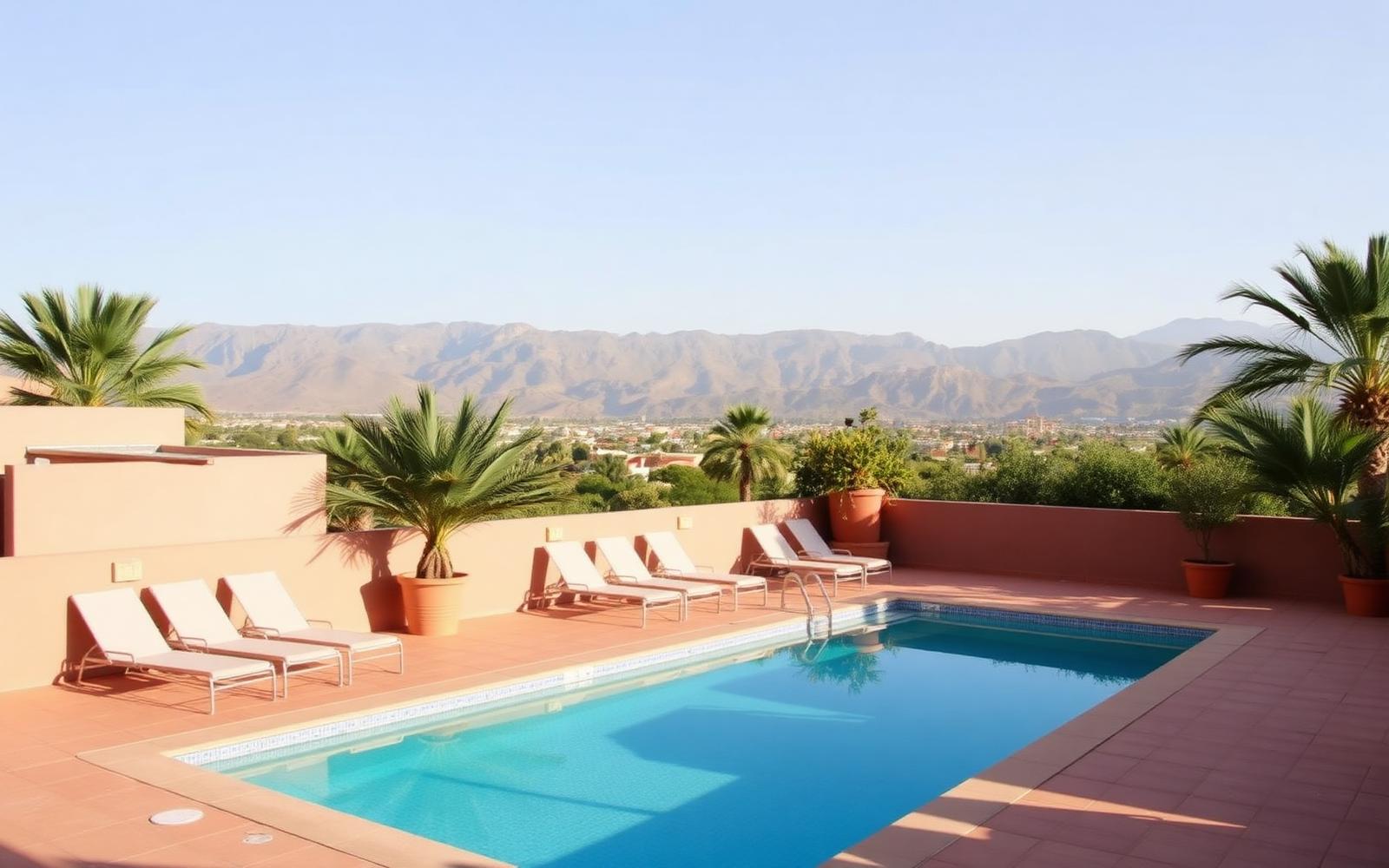
On short lets, three criteria dominate: a pool, vehicle access and immediate proximity to a hub such as Guéliz, Hivernage, the Palmeraie or the Ourika road.
A property without a pool easily loses 30 % of its nightly rate. A property that is hard to reach by car mainly loses occupancy, because family guests rule it out immediately.
Calculator: short term rental returns
Adjust the assumptions and the net result recalculates instantly. Defaults follow the worked example above.
Gross annual revenue
197,100 MAD
Management
- 49,275 MAD
Net result before tax
97,825 MAD
Net yield
6.5 %
Indicative simulation, excluding taxation and acquisition costs. To be validated asset by asset.
Sources
The figures in this guide are cross checked against the publications below. Check for updates before any decision.
- Morocco tourism statistics: arrivals and overnight stays · Observatoire du Tourisme (Maroc) · accessed 27 August 2026
- Key figures for the tourism sector · Moroccan Ministry of Tourism, Handicrafts and Social Economy · accessed 27 August 2026
- Tourist accommodation classification and operating obligations · Morocco national portal · accessed 27 August 2026
- France Morocco tax treaty: elimination of double taxation · French tax administration (impots.gouv.fr) · accessed 27 August 2026
Frequently asked questions
What return can you get from a short term rental in Marrakech?
Between 5 and 8 % net on a well located, well managed property, with annual occupancy of 55 to 70 %. Higher figures imply an actively operated guesthouse.
What do property managers charge in Marrakech?
Between 20 and 30 % of revenue for full management, with cleaning often billed separately. Partial management limited to marketing sits around 15 %.
When is low season in Marrakech?
July and August, because of the heat. Occupancy often falls below 40 %, which must be built into any return calculation.
Got a specific project in mind?
Guides set the framework. What follows depends on your objective, your horizon and the right asset at the right price.
See the opportunities